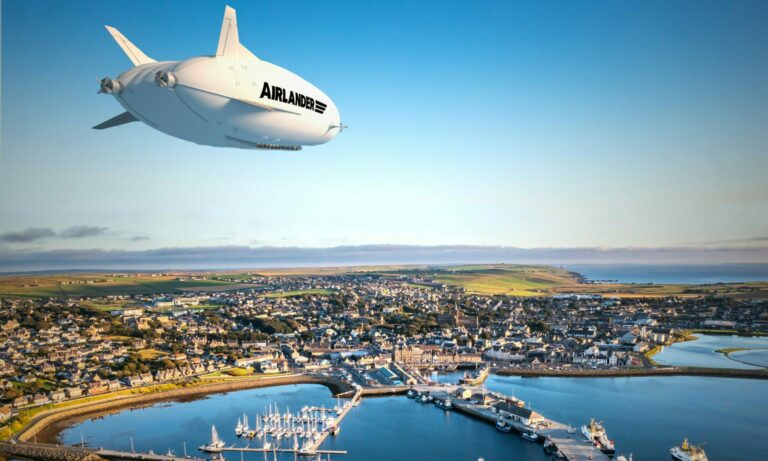
All-electric airships could soon be a familiar sight in Highland and Island skies – and on the water – if a concept study turns into reality.
Hybrid Air Vehicles [HAV] has commissioned the study to explore the use case for introducing an electric version of its Airlander 10 aircraft for passenger transport and freight in the Highlands and Islands by the end of this decade.
“HIAL managing director Inglis Lyon said: “HIAL’s aim is to become a net-zero carbon regional airport group. To achieve this, we need to investigate innovative solutions for sustainable air travel.”
— The Press and Journal (November 9, 2022)
The evalution is supported by a consortium of organisations including Highlands and Islands Airports [HIAL], Highlands and Islands Transport Partnership [HiTrans), Highlands and Islands Enterprise [HIE], Orkney Island Council [OIC] and Loganair.
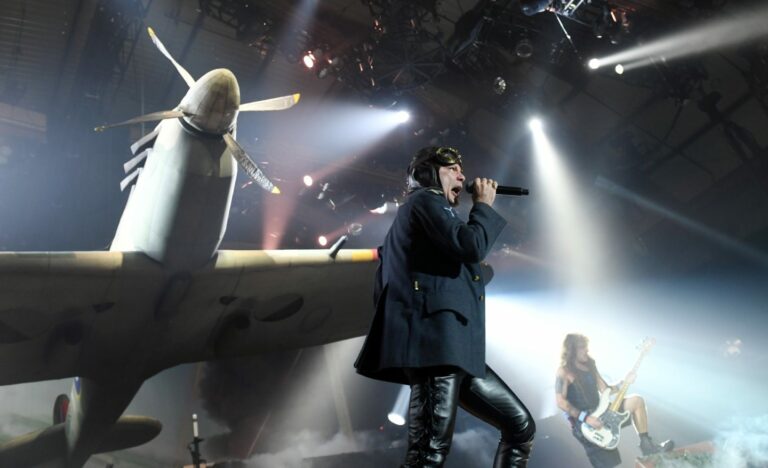
The company has some famous backing too in the form of Iron Maiden lead singer, Bruce Dickinson.
The heavy metal front man, already famous for piloting his own Boeing 757 clearly has aviation blood in his veins and lends some serious clout to getting the project off the ground.
Airships could provide alternative to ferry issues
HAV’s three-month evaluation will look to understand how Airlander 10 airships could support sustainable mobility in the Highlands and Islands, as well as provide a vital lifeline transport alternative in the teeth of increasing ferry service woes.
The study will compare emission reductions with existing transport options and assess the opportunities to operate at non-airport locations, taking advantage of the aircraft’s water operation capability.
The project will also consider Airlander’s potential to deliver freight with a combi variant of the aircraft. With a 10-tonne payload, Airlander 10 could boost regional passenger connectivity and logistics.
HIAL managing director Inglis Lyon said: “HIAL’s aim is to become a net-zero carbon regional airport group. To achieve this, we need to investigate innovative solutions for sustainable air travel.
“This collaboration allows us to explore the potential use of Airlander 10 as part of the region’s transport network. A network that provides essential and lifeline services to some of Scotland’s most remote regions.”
HAV Airlander 10 aircraft will enter service with Spanish regional airline, Air Nostrum Group in 2026.
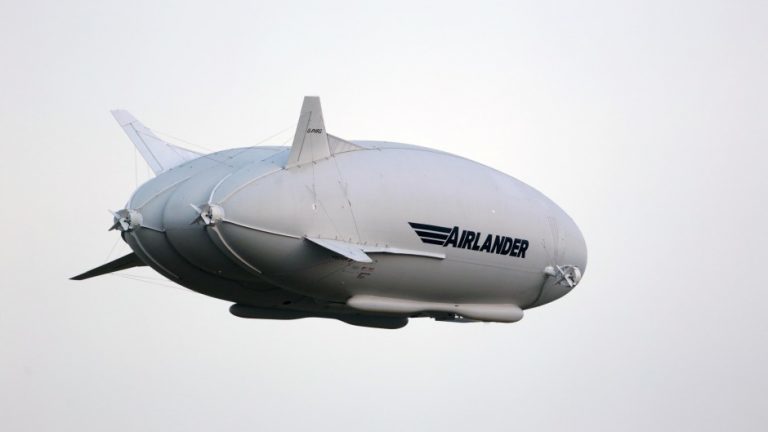
Standard Airlander 10 aircraft have four combustion engines, which the company maintains deliver up to 75% reduction in emissions compared to comparable aircraft.
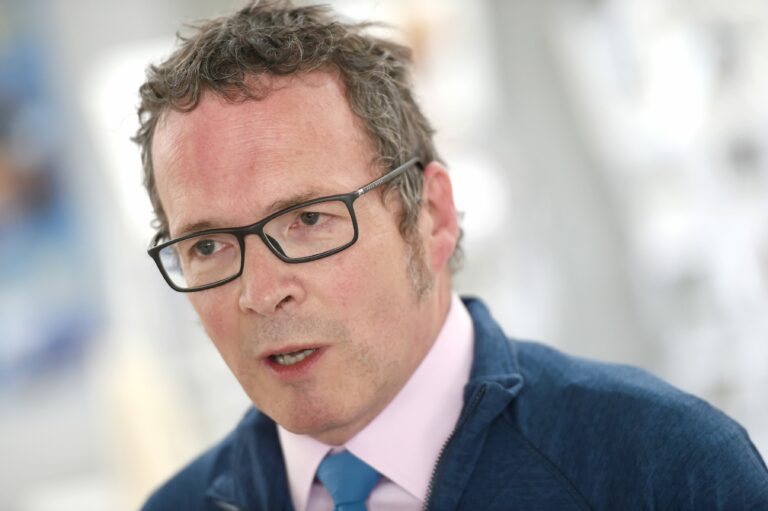
For his part, Tom Grundy, CEO of HAV said: “Hybrid Air Vehicles are changing the way we think about regional travel and sustainable aviation.
“This is particularly the case for sometimes hard-to-reach regions such as the Highlands and Islands.
“This study will, I hope, pave the way for a revolution in green short-haul flights in this wonderful, beautiful, if sometimes inaccessible, part of the world, boosting connectivity and the local economy as we do so.”
Helium offsets weight of airship
Bedford-based HAV is the company behind Airlander technology. The existing Airlander 10 aircraft uses a combination of buoyant lift from helium, aerodynamic lift (from air flow) to take off and vectored thrust to stay airborne.
The helium offsets the weight of the airship and as a result the company says it produces up to 10 times fewer harmful emissions than conventional passenger aircraft.
HAV expects Airlander to be the first large scale aircraft (capable of carrying up to 100 passengers or 10 tonnes) to achieve zero emissions flight.
A key feature is its ability to land anywhere, be it fields, tarmac or sea and as a result, does not need to rely on current airport infrastructure.
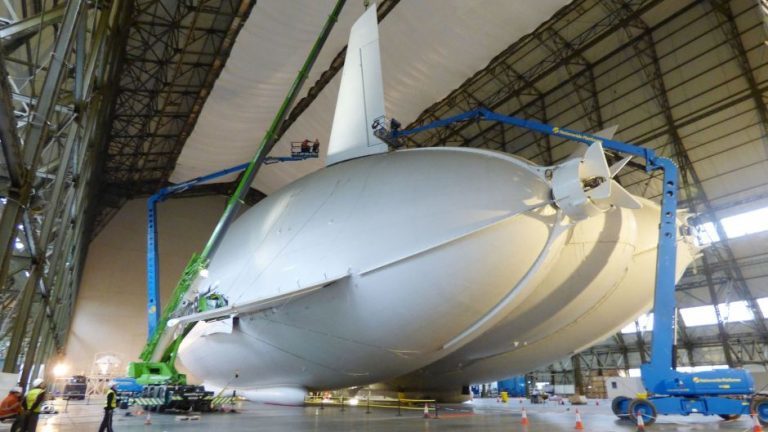
The production standard aircraft is expected to be in flight from 2023 and in service in 2026.
For regional passenger travel, typical trips on Airlander will be around 190-250 miles carrying a 10-tonne max payload and travelling at a top speed of 80mph.
HAV is working to launch the certification and production of Airlander aircraft this year. This will establish a new production line in South Yorkshire, employing more than 1,000 people.
The first three Airlander 10 aircraft to be built will be flying in 2025 and in service with customers including Spanish regional airline Air Nostrum in 2026. Pilot training and other activities will run alongside production to be ready for the aircraft to enter service.
The Airlander family of aircraft serves customers in mobility, logistics, experiential travel, communications & surveillance.