Category: High-speed rail

  • Fast track to the future- can the US love high-speed trains?

    Fast track to the future- can the US love high-speed trains?

    By Simon Warburton

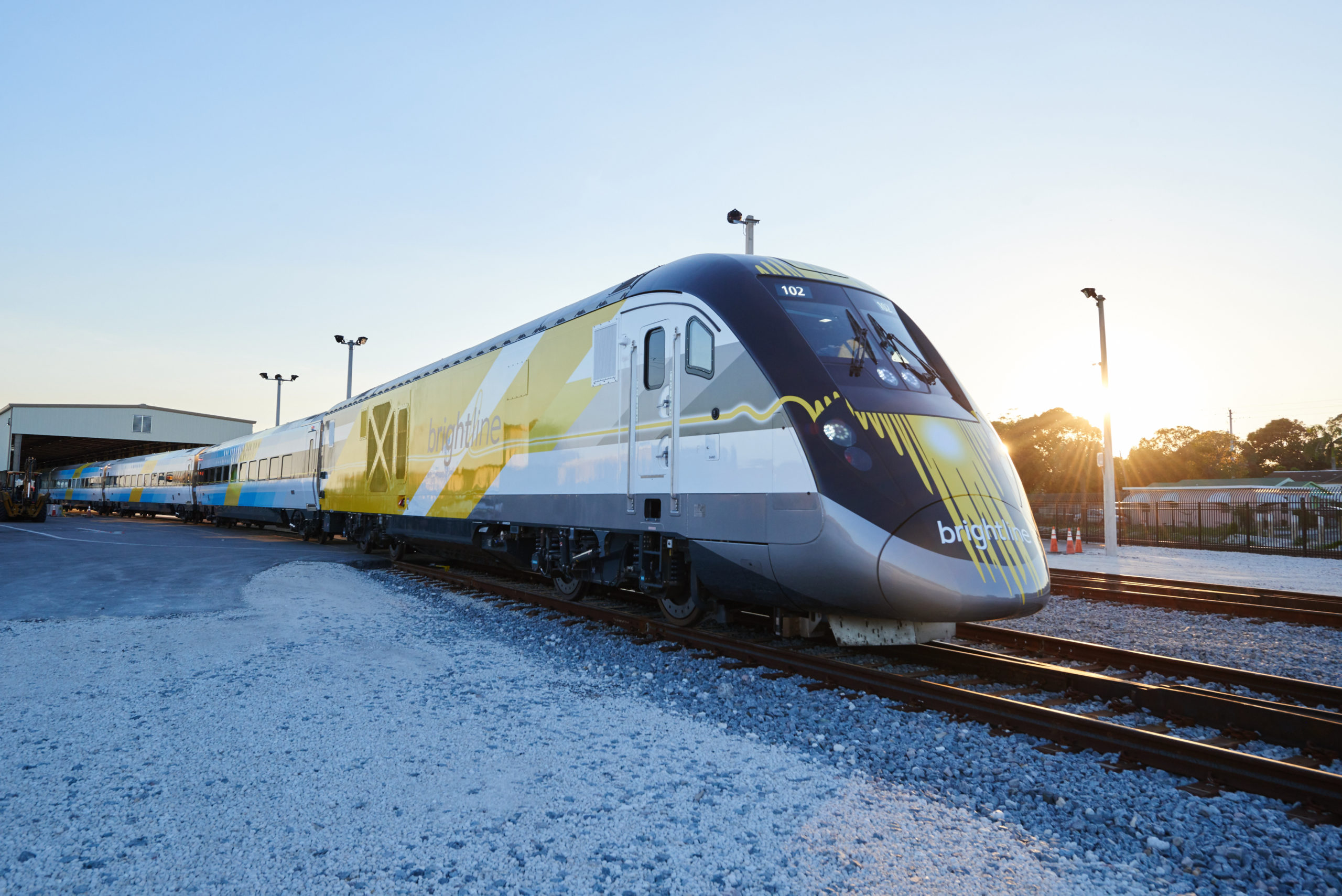
    Brightline runs 30 return services a day from Orlando to Miami. Image: Courtesy Brightline.

    American private train operator, Brightline, boldly claims it will remove 3m car journeys per year as its high-speed Florida rail services from Orlando Airport to Miami start to embed themselves in the transport mix.

    Linking the central Florida theme parks to the water playground of Miami with a rail track distance of 235 miles, the $5bn investment will be fascinating to watch if it can persuade Americans – notoriously wedded to four wheels and commercial flights – to ditch cars and aircraft in favour of trains.

    But just how far the US has to go in terms of high-speed (and from my British perspective we’re in no position to give the Americans any lessons, having just capitulated by abandoning our own swift link from Birmingham to Manchester), can maybe gleaned by the fact the Brightline Orlando journey starts at the airport.

    Orlando-Miami distance is ideal for high-speed rail. Image: Courtesy Brightline.

    If it’s one thing Americans like to do as well as drive, it’s fly, so maybe there’s a logic to basing the service out of Orlando Airport, but to be genuinely city centre to city centre, it surely one day has to originate in downtown Orlando.

    The Brightline route – to British ears at least – sounds impossibly glamorous: Orlando, West Palm Beach, Boca Raton, Fort Lauderdale, Aventura and Miami Central with anecdotal stories noting the journey can take around 3h30 if delays for signalling or crossings occur, but around 3h if not.

    A top speed of 125mph is possible – some way off the TGV and Shinkansen speedsters – but a decent lick nonetheless and not a traffic jam or airline cancellation in sight.

    And it’s that ease of journey which Brightline stresses in its promotion of the service, often repeating the phrase “too close to fly and too long to drive” to emphasise Orlando-Miami as the optimum distance to use the train.

    Trains feature components from 160 suppliers in 27 States

    Can you complete a day-return journey for work purposes? Dummying in a trip on 22 November, there is a Brightline service departing Orlando at 06:38, arriving into Miami at 10:11 with a return leg leaving at 18:46 and ending back in Central Florida at 22:19, so yes, it’s perfectly possible.

    Cost is $238 (£194) return in what Brightline terms its Smart or economy car, while the same journey would see you parting with $538 (£439) in Premium or business class.

    What will the passenger see for the $300 difference? Well, apart from probably a quieter carriage, there are a raft of benefits including wider seats (21 inches compared to 19 inches in Smart), free snacks, drinks and a Premium lounge (including conference room access).

    The lower Smart fare gives passengers complementary wi-fi, USB outlets at each seat, as well as on-board drinks and snacks available for purchase.

    The trains are produced at Siemens Mobility Sacramento Manufacturing Plant and feature more than 160 suppliers in 27 States – from brakes in South Carolina to cooling water systems in Michigan.

    Powered by what the company refers to as ‘FPL clean biodiesel,’ its locomotives are diesel-electric, while bicycles can be stored on-board.

    The trains look modern and spacious and the service is an ambitious move by Brightline to try and persuade Americans to ditch the automobile and take to the rails.

    Return day trips are eminently possible from Orlando to Miami. Image: Courtesy Brightline.

    There are an impressive 30 return trains (15 in each direction) per day linking Orlando to Miami and while national rail operator, Amtrak does ply the same route, travel on the same date would necessitate an overnight stay in Miami before returning the next day.

    To further tempt passengers to leave the car at home, Brightline offers a SoFlo Solo Pass with 40 personal use rides per month or a Shared Pass with 12 shareable rides per month.

    And until New Year’s Eve this year and using promotional code,  ALLABOARD at checkout, passengers can save 25% on Smart fares for a party of four or more, with a maximum of sixteen passengers per reservation.

    So far, the US has been dominated by Amtrak’s nationwide rail network with the American government as majority shareholder and serving more than 500 destinations in 46 States, the District of Columbia and three Canadian provinces.

    The Amtrak network (according to the 2022 company profile) spans 21,400 miles of routes, but when you consider America’s size and compare it to the UK, which has 20,000 miles of railtrack on its own (France, 18,600 miles), there is clearly a massive amount of work to do to tempt travellers across the pond to hop on a train.

    Nonetheless, Amtrak, which is significantly upgrading multiple stations, says it operates intercity trains at speeds of up to 150mph, while nearly half of all services reach 100mph.

    Amtrak was recently awarded nearly $10 billion in Federal Railroad Administration (FRA) funding from the US government to modernise critical infrastructure, improve stations and support growth on the Northeast Corridor (NEC).

    The company notes “NEC ridership continues to rise,” exceeding pre-pandemic levels since early summer.

    “These grants will help advance Amtrak’s plans to modernise the Northeast Corridor and unlock major bottlenecks on the busiest passenger rail corridor in America,” said Amtrak CEO Stephen Gardner

    Will Amtrak face increasing number of rivals? Image by 70154 from Pixabay.

    Brightline has someway to go to reach the size of Amtrak, but it does have the advantage of being seen as the disruptor and providing a shiny new product to compete with legacy operators.

    The sheer regularity of its 30 daily services shuttling between Miami and Orlando may persuade punters it is a viable option to just turn up and go, while the airlines will be casting a forensic eye to see if their passengers are tempted away.

    When Eurostar became a reality between London and Paris, the Channel Tunnel eventually saw off flights from Gatwick to Paris Charles de Gaulle as the sheer hassle of slogging in and out of airports nowhere near the city centre was replaced by easy – and good value – services between the two capitals. And just as an added bonus, no luggage limits or fussing about with separating liquids at security to boot.

    It’s perfectly possible to fly from Orlando to Miami, but could Brightline eventually replace the plane with the train?

    US is not a static rail environment

    Maybe it makes more sense to view the US as what it is – 50 separate States – effectively 50 different countries – rather than as a potential for a homogenised nationwide high-speed rail service.

    There has been much talk about fast trains between San Francisco and Los Angeles – a perfect distance of 350 miles as far as high-speed trains go – much further and commercial flight options start to become more attractive.

    Meanwhile, Texas Central and Amtrak are looking to analyse work on the proposed Dallas-Houston 205mph rail project to examine its viability. If the project comes to fruition, it would see a seriously impressive journey time of less than 90 minutes, with one stop in the Brazos Valley.

    So things are happening in America. It’s not a static rail environment and maybe private/public partnership is the way to go, at least to start with as a way of addressing colossal costs in building track.

    Will American trains have to offer raft of extras compared to airlines? Image: Courtesy Brightline.

    And of course, lurking in the background as ever, is the much-touted ‘hyperloop’ concept, promising much but so far still on the drawing board.

    The US will have to work much harder than, say Europe, in persuading its citizens to ditch the car or commercial flights.

    American train services will maybe have to offer a dazzling array of goodies to tempt people onto rail, benefits that road and air just can’t compete with.

    Clearly, nationwide rail in America has some way to go. But Brightline and others are pointing the way to provide genuine competition to traditional transport modes.

    One to watch.

    If you need editorial contributions or website content, I am a journalist with more than 30 years of experience. Please contact me at: simon.warburton@voyagerpro.co.uk and see my portfolio at: voyagerpro.co.uk
  • Off the rails – latest rumours

    Off the rails – latest rumours

    By Simon Warburton

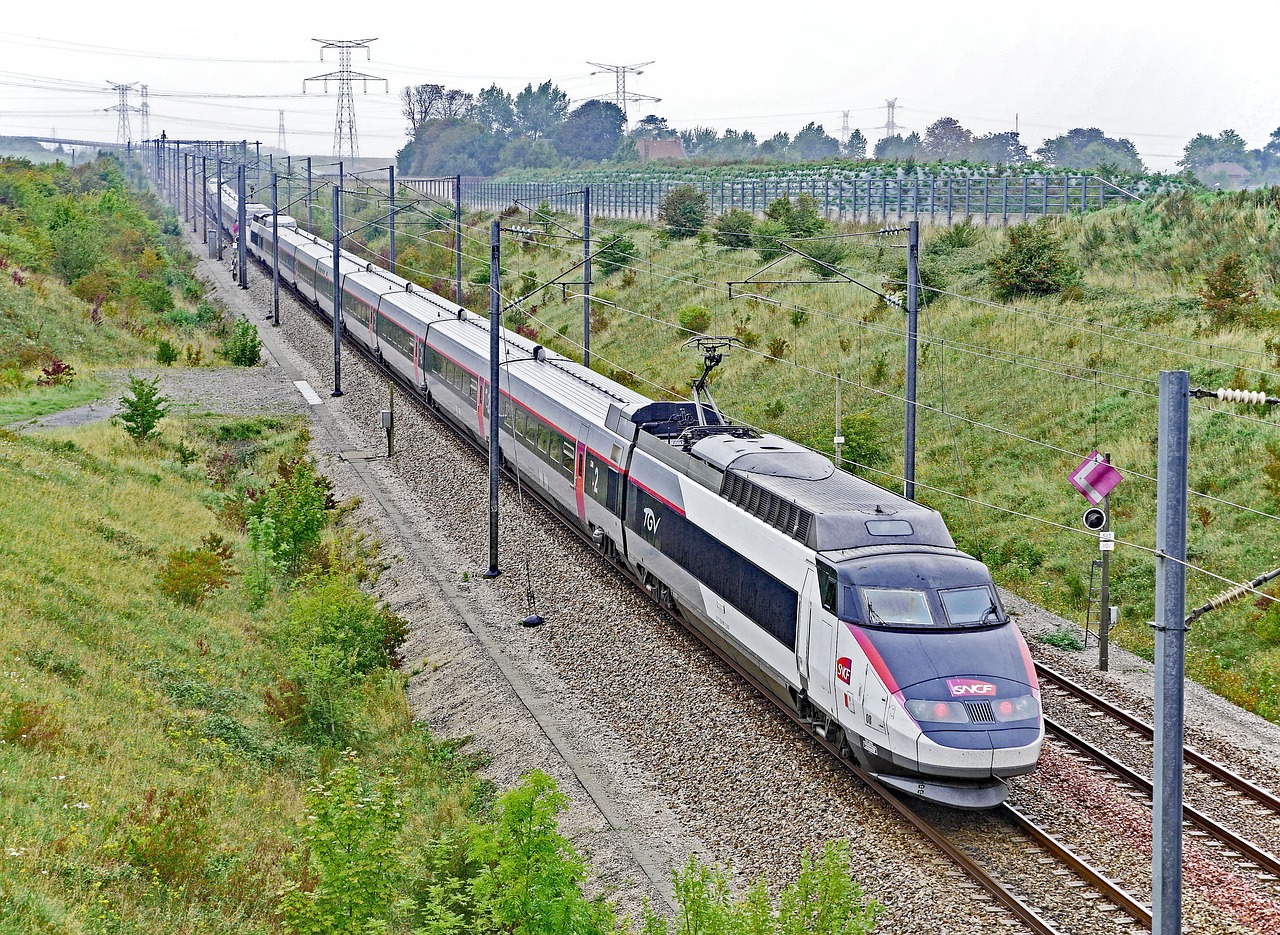
    French TGV trains were European trailblazers. Image courtesy hpgruesen – Pixabay.

    I didn’t think it was possible to be even more bowled over by the fiasco currently stalking what remains of Britain’s woeful attempts at building a high-speed network, but the jungle drums are beating louder now about the potential scrapping of the northern link to Manchester.

    I recently posted a blog (see below) on my website – voyagerpro.co.uk – surrounding what I believe is a chronic and woeful lack of ambition on behalf of the UK to build a high-speed network and catch up with much of the rest of Europe, but if rumours the HS2 line will stop at Birmingham are true, then the whole sorry project is utterly pointless.

    This might be just white noise – speculation has never really deviated from being at fever pitch with HS2 – but if it is reality, the entire undertaking is doomed.

    Today, I can quite happily catch a relatively fast train from Euston in Central London to Birmingham New St in the heart of Britain’s second city in around 1h20min.

    What’s the point of paying – presumably a premium – to catch an HS2 service from somewhere not in the middle of the capital to somewhere not in the middle of Birmingham?

    I sincerely hope rumours of HS2’s northern link to Manchester being canned are just that. But what I wrote a few weeks ago still holds.

    Where is the UK’s transport vision? HS2 could offer so much, but has been relentlessly attacked ever since it first saw light of day on a drawing board.

    It was with some incredulity I read the two HS2 boring machines destined to scoop out thousands of tons of earth, are being mothballed underground some tantalising five miles short of their intended destination of Euston Station in London.

    As if this project – assailed on all sides by doom-mongers and nimbys – wasn’t bizarre enough, it seems the tunnelling machines will be blessed with a statue of Saint Barbara – apparently the patron saint of tunnelling – who knew? – before their incarceration.

    But the lowering of the giant German borers into their tomb for two years – maybe more – as the eternal wrangling surrounding this seemingly never-ending project sucks up ever more momentum – symbolises a crushing lack of ambition for UK PLC.

    Take your pick of eye-watering HS2 cost estimates thrown in the air like confetti; they range from anything approaching £100bn to a frankly ridiculous £200bn.

    Don’t let UK rail take a step back

    Where is the ambition, the drive, the can-do, the inspiration for Science, Technology, Engineering and Maths (STEM) students to witness the classroom translated into world class reality?

    When Concorde was abruptly pulled from service – it was the first time in aviation’s short history a backward step had been taken.

    If HS2 is ultimately and quietly shelved, what signal does that send about Britain’s engineering and infrastructural prowess? It relegates us to a second-rate rail system and an exorbitantly expensive one at that. We will have decidedly followed Concorde and stepped backwards.

    Spain is rapidly developing an impressive high-speed network. Image courtesy Vlada11 – Pixabay.

    Did Isambard Kingdom Brunel give in to the naysayers – of which I’m sure there were plenty – as he overcame the myriad problems associated with building his London to Bristol train line? He did not and is rightly lauded today as one the greatest Britons ever, leaving a legacy of engineering landmarks which marked the UK out as a global powerhouse of hi-tech.

    HS2 isn’t some abstract vanity project; it is supporting 28,500 jobs and has created 1,200 apprenticeships already says the company.

    Some 2,760 suppliers, many of them SMEs, are involved and expect many more jobs to flow if this benighted project ever goes to full fruition.

    I’ve seen the HS2 works mushroom at Birmingham Curzon Street, which is due to be operational by the early 2030s. Is all that work, that know-how, going to disappear as Britain gives up on ambition?

    HS2 is designed to increase capacity

    Endless opposition is kicking this rail can down the road. I’ve also heard people argue the HS2 money could be spent on upgrading the existing rail system; just who are they kidding?

    Do they honestly think whichever government of the day will magically release £100bn, £150bn into upgrading British trains, track, stations, infrastructure? It simply will not happen, that hypothetical money will just become swallowed by myriad other competing projects and passengers will be left to languish on our overcrowded and over-pricey existing services.

    HS2 is designed to increase capacity, free up space to pluck freight off UK motorways and on to green rail. Isn’t that what the eco warriors currently disrupting sporting events want?

    Britain’s population is rapidly expanding. We’re an island with finite geography – getting cars off roads means extra rail capacity is desperately needed and HS2 is part of, but certainly not all, of the answer.

    St Pancras is a stunning example of what the UK can do in rail infrastructure. Image courtesy Pharaoh_EZYPT – Pixabay.

    But HS2’s scope is woefully limited. If you can’t even arrive at Euston Station in Central London, what’s the point? If the high-speed services don’t even make it to Leeds, Glasgow and Edinburgh, what’s the point?

    The pandemic virtually shut down rail travel in the UK for an immense period of time, requiring an increase to a colossal £16bn of taxpayers’ money to prop up many ghost trains rattling around the country with very few passengers for obvious reasons. (The current strike-happy rail unions seem to conveniently ignore how much of the people’s cash has already been forked out to ensure the network continued).

    Covid has also seemingly put the contentious third runway at Heathrow Airport into the long grass, but the airport is already reporting it is back to 80%-90% of 2019 passenger numbers. Pressure on its existing two runways, already almost saturated, will only grow and will catapult the capacity issue straight back to the fore.

    If the environmental hardliners succeed in seeing off that third pavement at LHR, then we will urgently need the sort of heft HS2 affords. And that’s why high-speed has to go to Scotland, obviating the need for domestic flights and that’s why Heathrow needs a spur to link it to the high-speed network.

    Three hours from Paris to Marseille

    France has recognised the power of its swift trains and banned certain flights where it’s possible to take a train trip of less than 2.5h.  We should do the same and do our bit for the polar bears, but oh hang on, we haven’t got a high-speed network.

    Step off an aircraft at Charles de Gaulle Airport in Paris and you can quickly board a shiny TGV to all points of France’s compass. What happens to those who praise the French TGV system – and now increasingly Spain, which is launching competing services to SNCF – quelle horreur! – but who then return home to lambast the only significant engineering project of its scale the UK has?

    I travelled by an SNCF double-decker TGV from Paris’ glorious Gare de Lyon (its Le Train Bleu restaurant is a wonder to behold) down to Toulon, a distance of 431 miles, which the French iron horse polished off in a shade less than four hours. (3h to Marseille).

    And of course Japan has long had its fabled Shinkansen high-speed trains.

    Compare that to say, London-Aberdeen (400 miles) and the quickest service I could find came in at at a whopping 7h06m with a hefty price tag to boot.

    Japan has long had its famous Shinkansen trains. Image courtesy ArminEP – Pixabay.

    The nimbys complain the UK is half the size of France and we don’t have room for a high-speed line. Well, as soon as the rattler noses out of the capital, there is in fact plenty of room, but some are so ideologically opposed, they can’t see the wood for the literal trees.

    HS2 has made myriad commitments to protect – and in some cases – enhance the environment. There will be disruption for sure, but in hard cash terms, the injection of finance into the UK supply chain will be immense.

    There is one tiny section of British high-speed line and very successful it is too, carrying 16-carriage Eurostars to Paris and Brussels, their trains flashing through the Kent countryside in no time.

    St Pancras station shows what Britain can do

    And in a rare example of Britain trumping France, the astonishingly impressive St Pancras Eurostar station in London knocks Gare du Nord in Paris into a cocked hat.

    Before that UK high-speed line was built, I remember a cartoon depicting a sleek French Eurostar, having bulleted across from Paris, hissing into Folkestone.

    The caption read something like: “Would passengers please transfer to the British connection to London.” Depicted was a waiting horse and trap with some bewildered people on board. “Gee up Dobbin”  said the driver.

    Brunel will be turning in his grave at the UK’s staggering lack of ambition.